
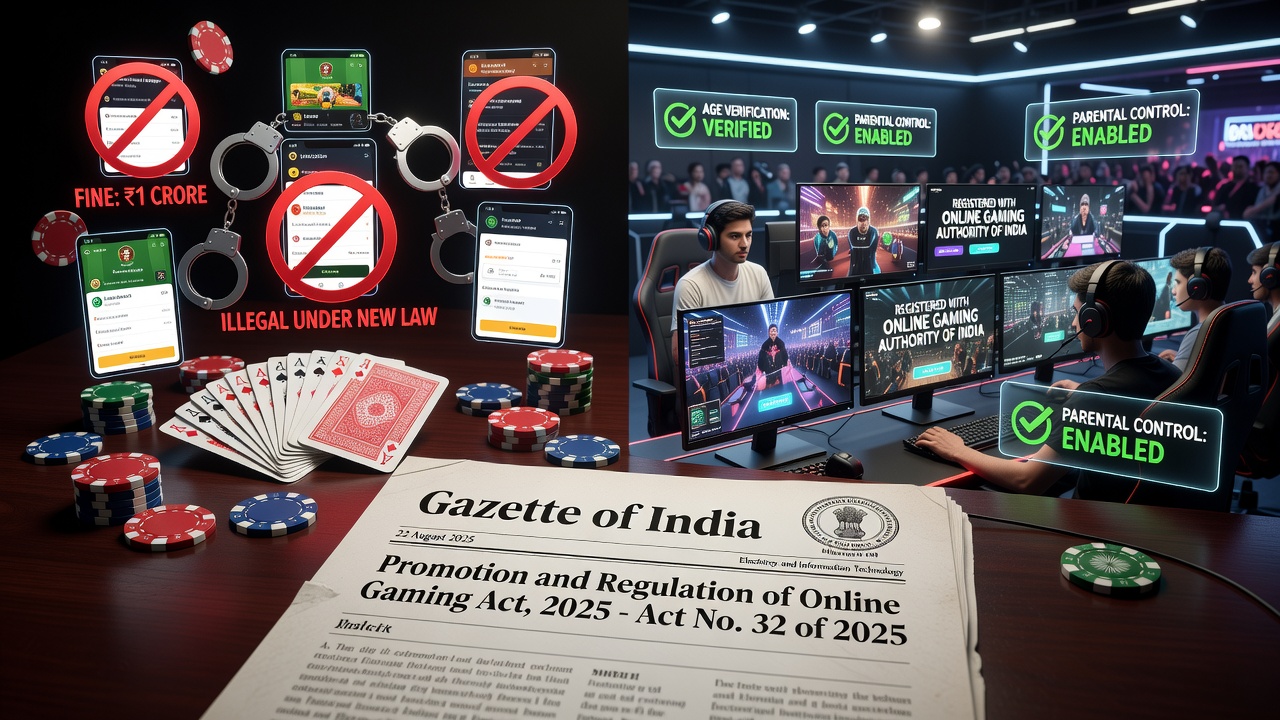
India has drawn a hard legal line between games played for entertainment and games played for cash. The Promotion and Regulation of Online Gaming Act, 2025 - Act No. 32 of 2025, published in the Gazette of India on 22 August 2025 - prohibits online money games across the country, while simultaneously creating a framework to promote e-sports and online social games. The law applies to the whole of India and reaches beyond its borders, covering money gaming services operated from abroad but offered to Indian users.
Why "Skill" No Longer Matters
For years, operators of rummy, poker and fantasy sports platforms relied on a legal distinction between games of skill and games of chance, arguing that skill-based formats sat outside gambling regulation. The 2025 Act removes that argument entirely. Under Section 2, an online money game is defined as any game - skill-based, chance-based or a mix of both - played by paying fees, depositing money or staking value in expectation of winning money or other enrichment. E-sports are explicitly excluded from this definition, which is what allows competitive gaming to continue under a promotional, registration-based model rather than a prohibition.
The Act effectively creates three categories: online money games, which are banned outright; e-sports, which are promoted and must register with a regulatory authority; and online social games, which are promoted and require no money-for-money stake, with registration triggered only when the government specifically notifies a category.
Who Actually Faces Prosecution
The law does not criminalise the individual player. Instead, Section 9 creates three distinct offences aimed at the business side of the industry:
- Offering or assisting in offering an online money game - up to 3 years imprisonment and a fine of up to 1 crore rupees
- Advertising or inducing participation - up to 2 years imprisonment and a fine of up to 50 lakh rupees
- Facilitating payments for such games, including by banks and financial institutions - up to 3 years imprisonment and a fine of up to 1 crore rupees
Repeat offenders face steeper mandatory minimums - three to five years for offering or payment facilitation, two to three years for advertising - alongside higher fines. Offences tied to offering a game or processing its payments are cognizable and non-bailable, meaning police can arrest without a warrant and bail is not automatic. Company directors and officers can be held personally liable, and enforcement officers are empowered to search and arrest in both physical and digital spaces.
This structure leaves players in an ambiguous position. They are not named as offenders, but the ban on payment facilitation means banks and payment processors are legally barred from moving money toward these services. In practice, that translates into blocked deposits, reversed withdrawals and frozen transactions for anyone attempting to use such platforms, regardless of whether the user is prosecuted.
How the Rules Will Work From May 2026
The Promotion and Regulation of Online Gaming Rules, 2026, published on 22 April 2026 and effective from 1 May 2026, set up the machinery behind the Act. A new Online Gaming Authority of India, operating under the Ministry of Electronics and Information Technology and chaired by an Additional Secretary, will determine - within roughly 90 days where practicable - whether a given game qualifies as an online money game, and will maintain a public list of such games.
Registration is mandatory for every e-sport offering and for social game categories once the government specifically notifies them. Registered providers must implement age verification, age-gating, time-use restrictions, parental controls and a formal grievance mechanism. Users dissatisfied with how a provider handles a complaint can escalate to the Authority within 30 days, with a further appeal available to the Ministry's Secretary.
Section 14 adds a content-blocking mechanism: where the rules on offering, advertising or payment facilitation are breached, information about the service can be blocked from public access under the Information Technology Act, 2000. The law also overrides other statutes where there is inconsistency, giving it precedence in this specific domain - though it does not touch state-level gambling laws or physical casinos, which remain governed separately.
What This Means for the Market
For operators, the practical effect is a forced business-model split: real-money gaming products built around rummy, poker, fantasy sports or similar formats lose their legal footing in India entirely, while e-sports and non-monetary social games gain a formal, registered pathway to operate and seek legitimacy. For payment providers and banks, the law creates direct compliance exposure - facilitating a transaction for a prohibited game carries the same penalty tier as running the game itself. For advertisers and platforms carrying gaming promotions, the separate offence for inducement means marketing activity is now a prosecutable act on its own, independent of who operates the underlying game.
Anyone affected by existing deposits, pending withdrawals or ongoing disputes with a gaming platform should seek independent legal advice rather than assume continuity of service. Gambling-related products carry an inherent risk of financial loss, and regulatory uncertainty of this scale adds a further layer of risk around access to funds already deposited with a platform.