
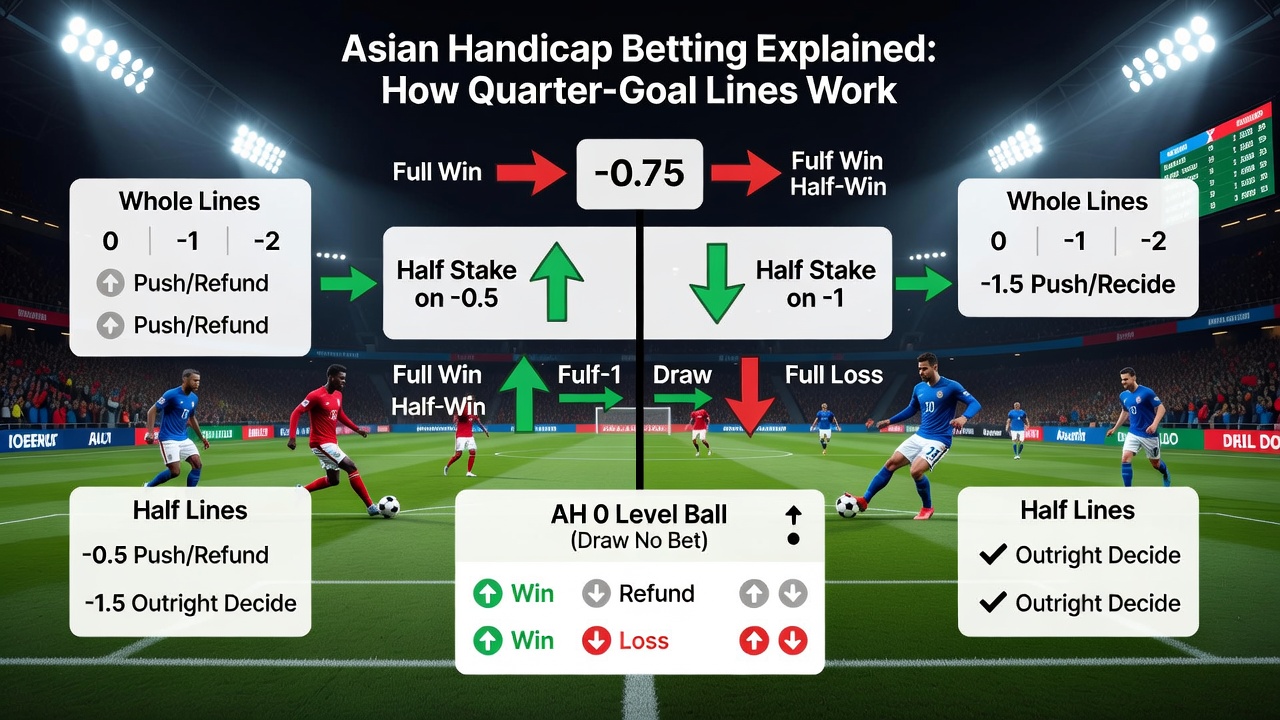
Asian Handicap betting strips the draw out of football wagering by assigning a virtual goal advantage or deficit to one side before kick-off. Instead of three outcomes - home win, draw, away win - bettors choose between two sides, with the handicap applied to the final score to determine settlement. The format has become a staple of serious football betting because it offers finer control over risk and value than traditional 1X2 markets.
Why the draw disappears - and why that matters
Standard match-result betting forces a three-way split of probability, which tends to dilute value on heavy favourites and inflate the perceived chance of an upset. Asian Handicap removes that friction by handicapping the stronger side. A team given a -1 handicap must win by two or more goals for the bet to succeed outright; the underdog, receiving +1, only needs to avoid losing by two or more. This restructuring means odds on both sides of the market tend to sit closer to even money, which is part of why AH has become the dominant format in many Asian and European betting markets.
Whole lines, half lines, and the mechanics of quarter-goals
Handicaps come in three forms. Whole-goal lines such as 0, -1 or -2 can produce a push - a full refund - if the match finishes exactly on that margin. Half-goal lines such as -0.5 or -1.5 remove that possibility entirely, since no match can finish on a half-goal margin; one side always wins the bet in full. Quarter-goal lines - -0.25, -0.75, -1.25 and so on - are the distinctive feature of the format. They do not exist as a single market at all; they are a mechanical split of the stake across two adjacent lines.
A -0.75 handicap, for example, places half the stake on -0.5 and half on -1. If the favourite wins by two goals or more, both halves settle as wins. If they win by exactly one goal, the -0.5 portion wins but the -1 portion voids, producing a half-win rather than a full one. If the match is drawn or lost, the entire stake is lost. This structure means quarter lines generate four possible settlement outcomes - full win, half win, half loss, full loss - compared with the binary win/lose/push outcomes of whole and half lines.
- AH 0 (Level Ball): functionally identical to Draw No Bet - win if your side wins, refund on a draw, lose if they lose.
- Half lines (-0.5, -1.5): no refund possibility; the match margin always decides the bet outright.
- Quarter lines (-0.25, -0.75, -1.25): stake is split across two adjacent lines, allowing partial wins and partial refunds.
Why AH 0 and Draw No Bet aren't always priced the same
AH 0 and Draw No Bet produce identical settlement logic, yet they are frequently priced differently by bookmakers. This is largely a function of liquidity and margin structure. Asian Handicap markets, particularly on major fixtures, tend to attract deeper trading volume and tighter bookmaker margins than standalone Draw No Bet markets, which are often treated as a secondary product built around the same underlying probabilities. The practical effect is that two markets with identical settlement rules can carry meaningfully different odds, and comparing them before placing a bet is a straightforward way to assess whether value exists.
Modelling margins, not just outcomes
Pricing Asian Handicap accurately requires more than estimating who wins. It requires estimating the full distribution of winning margins - the probability of a one-goal win, a two-goal win, a three-goal-plus win, and so on. Statistical approaches such as Dixon-Coles modelling, which incorporate attack and defence strength, home advantage, and recent form, are built precisely for this purpose. The output allows a bettor or analyst to test expected value across every handicap line on offer, rather than assuming the most popular or lowest-risk line is automatically the best one. A heavy favourite with a high probability of winning by three or more goals may offer stronger expected value at a deep handicap like -2.5 than at a seemingly safer -1, even though the deeper line carries more settlement risk.
Reading the risk honestly
Asian Handicap's structural sophistication does not change the fundamental nature of sports betting: outcomes remain uncertain, and no staking approach or market format guarantees a return. Quarter lines can soften losses and preserve partial value in close results, but they can equally produce partial losses in matches that fall just short of covering. Any publicised win-rate figures should be read alongside the odds at which they were achieved and the sample size involved, since both materially affect long-term profitability. Bettors should treat Asian Handicap as a more precise way to express a view on a match, not as a method for reducing the underlying uncertainty of the sport itself. Anyone concerned about their gambling behaviour can find independent support through BeGambleAware.org, and betting products of this kind are intended strictly for adults aged 18 and over.