
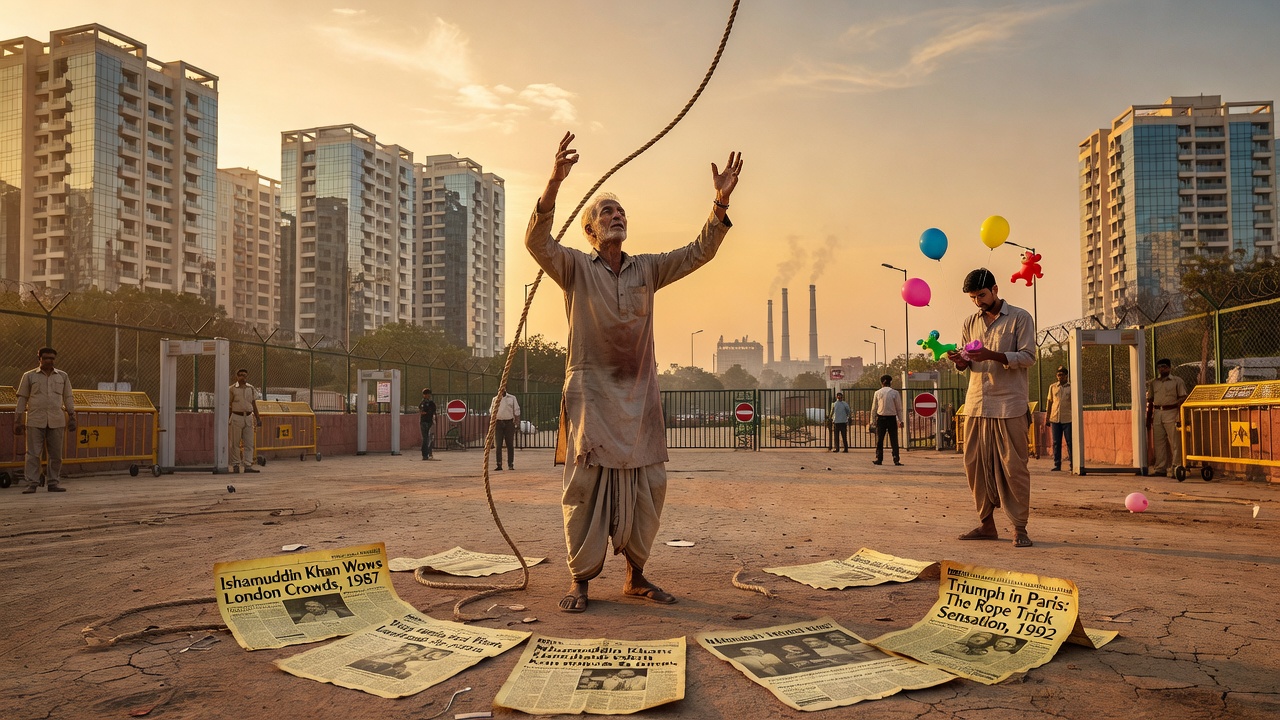
Ishamuddin Khan can still make a rope rise into the air with nothing but his hands and decades of practice. The 55-year-old magician, once celebrated internationally for reviving a trick long dismissed as folklore, now spends more time with old newspaper clippings than with paying audiences. His trade, and the community that built it over generations, is disappearing from India's streets.
A craft rooted in centuries, undone in decades
Khan belongs to the Madari community, a group of traditional performers with roots stretching back through Indian folklore and oral history. Skills such as the rope trick, juggling and puppetry were passed from father to son, learned not in schools but in households and open-air performances. Khan himself began training under his father and uncles at age 12, mastering his signature trick by his early twenties. His 1995 performance outside Delhi's Qutub Minar, followed by a show before 30,000 spectators in Karnataka, brought him tours across the UK, France, Germany and Japan. That international recognition, however, never translated into a durable livelihood for the wider community he represents.
Shrinking public space, tightening rules
Street performance depends on open, accessible public ground, and that ground is disappearing. Gated residential complexes, closed parks and heightened security in commercial districts have cut off the informal pitches performers once relied on. India has no federal framework governing busking, unlike some countries where licensed street performance is formally recognised. Instead, artists must work around a patchwork of municipal rules on public order, noise and obstruction, alongside state-level anti-begging statutes that can blur the line between a voluntary tip and a punishable offence. For a profession built on spontaneity, that legal ambiguity makes planning a livelihood difficult.
Pandemic disruption and the pull of digital entertainment
The 2020 lockdown halted public gatherings nationwide, and for many performers it marked a permanent exit from the trade. Magicians returned to their home villages and did not come back to cities once restrictions lifted. Those who remained, like Shahim Khan, describe earnings that have fallen by more than half compared with pre-pandemic days, as fewer shows are possible in the industrial areas now left available to them. Short-form digital entertainment has reshaped what audiences expect and where they look for it, leaving little appetite for the unhurried, crowd-gathered spectacle that street magic requires.
What disappears when the trade does
The economic story is also a cultural one. Ishamuddin Khan's son, Altamash, performed as a teenager but now works decorating parties with balloons, his juggling skills fading from lack of practice. Without a reliable income, fewer young people in Madari families are choosing to learn tricks that took their parents years to perfect. Historians note that these traditions survived centuries of change by passing directly from one generation to the next. That chain now faces a break not from lack of talent, but from the absence of space, audience and economic reward.