
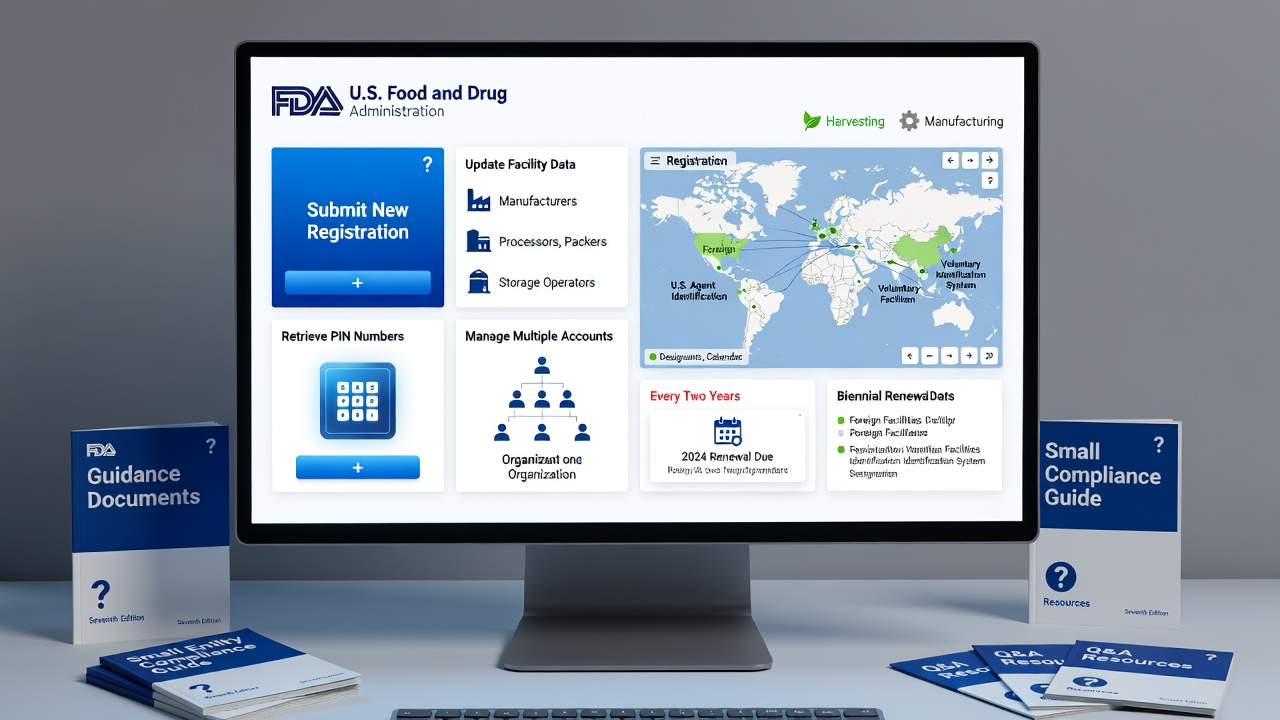
Food companies selling into the United States market face a recurring administrative obligation: registering their facilities with the Food and Drug Administration and renewing that registration every two years. The agency's primary tool for managing this process, FDA Industry Systems, has operated continuously since October 2003, giving manufacturers, processors, and storage operators around-the-clock access to file registrations, listings, and related notifications online.
Why Facility Registration Matters
Under U.S. food safety law, most facilities that manufacture, process, pack, or hold food for consumption in the United States must register with the FDA. This requirement exists so regulators can trace products quickly during contamination investigations, recalls, or bioterrorism concerns. Registration is not a one-time formality - it requires biennial renewal, and failure to renew or update records can result in a facility's registration being deemed expired, which carries legal and commercial consequences for firms trying to move goods across the border or through domestic distribution.
The FDA Industry Systems platform centralizes these obligations into a single digital environment. Businesses can create accounts, submit new registrations, update existing facility data, retrieve lost PIN numbers, and manage multiple registrations under one organizational account. The system also supports the Voluntary Identification System for U.S. Agents - a mechanism relevant to foreign facilities, which are required to designate a U.S.-based agent as a point of contact for the agency.
Guidance Documents and Compliance Support
Because registration requirements involve technical distinctions - for instance, how the agency classifies harvesting versus manufacturing or processing activities for farms - the FDA has published a series of guidance documents alongside the digital portal. These include a small entity compliance guide aimed at smaller operators with limited regulatory staff, a question-and-answer resource now in its seventh edition, and draft guidance addressing activity classification for farms and facilities. For businesses uncertain whether registration fees apply to their operation, or wary of third parties falsely claiming affiliation with the agency, the FDA has issued direct clarifications to reduce confusion and prevent fraud.
This layered approach - a functional online system paired with detailed interpretive guidance - reflects a broader pattern in regulatory technology: agencies increasingly pair digital self-service tools with plain-language documentation to reduce compliance errors without requiring constant direct contact with regulatory staff. It also shifts some administrative burden onto businesses to stay current with renewal cycles and data accuracy, since registrations lapse automatically without biennial action.
Security and Communication Safeguards
The FDA has specifically advised facilities to protect their registration information from unauthorized access or manipulation, a notice that points to a wider concern across regulated industries: credential theft and account tampering affecting compliance records. Businesses are also directed to recognize legitimate FDA correspondence by whitelisting the agency's official email domains, a precaution against phishing attempts that impersonate government communications. This kind of guidance has become routine across regulatory bodies as email-based fraud targeting businesses with compliance deadlines has grown more sophisticated.
- Registration must be renewed every two years during a designated biennial period.
- Foreign facilities generally need a U.S. Agent, which can be identified through the Voluntary Identification System.
- Facilities can manage registration status, cancel entries, or transfer registrations between accounts through FIS.
- Official FDA communications originate from "@fda.gov" or "@fda.hhs.gov" domains.
Implications for Industry Operators
For food businesses, the practical takeaway is operational rather than strategic: registration compliance is a recurring administrative task, not a one-off filing. Missing a renewal window, failing to update facility details after a change in ownership or operations, or losing access to account credentials can create downstream friction with distributors, retailers, or customs authorities. As the FDA continues to refine its digital infrastructure, businesses that treat registration as an ongoing compliance function - rather than a box checked once - are better positioned to avoid disruptions tied to lapsed or inaccurate records.