
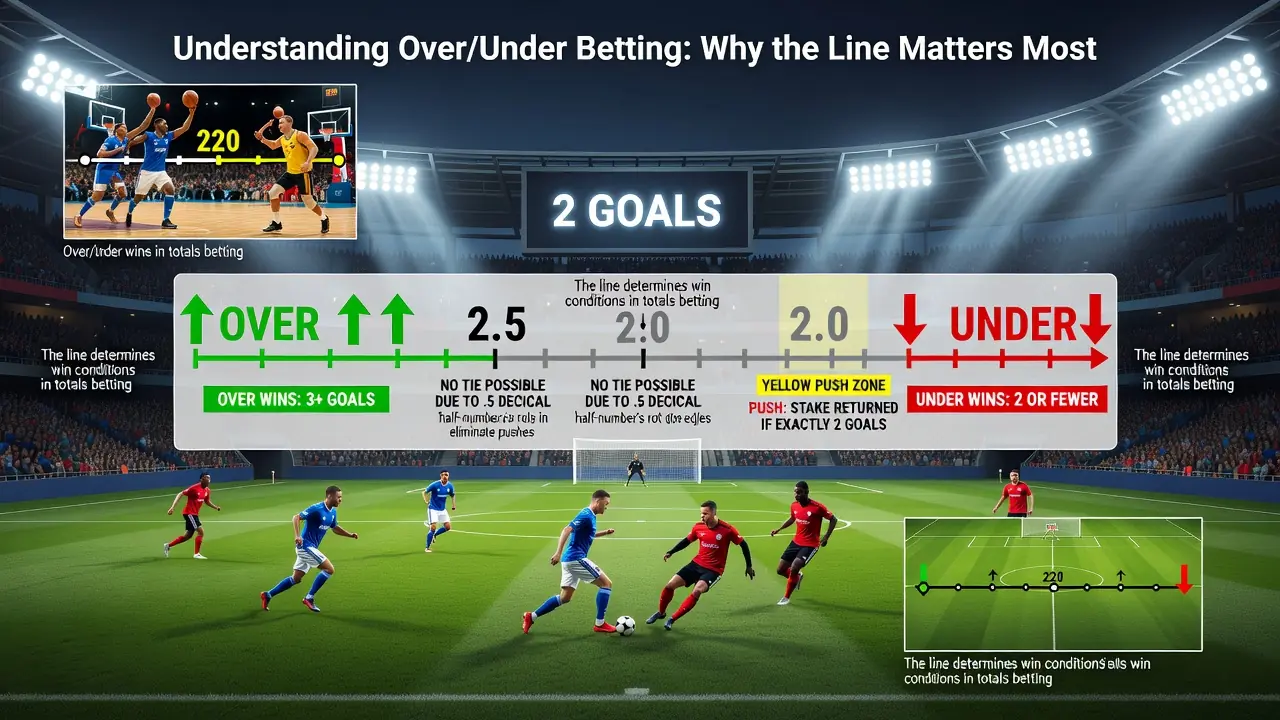
A single decimal point separates a winning bet from a losing one in over/under markets, and many casual bettors misunderstand what that decimal actually controls. Over/under betting, also called totals betting, asks a simple question: will a combined statistic finish above or below a set number? The mechanism looks simple on the surface, but the mathematics behind the line itself carries real consequences for how operators price markets and how bettors should read them.
How the Line Determines the Outcome
In football, the most common total is goals scored by both teams combined. A line of 2.5 goals means a bettor wagering on the over wins only if three or more goals are scored across the match; the under wins if the match produces two goals or fewer. Because 2.5 is not a whole number, there is no scenario where the total lands exactly on it - every match resolves one side of the bet or the other. That is precisely why operators favor half-number lines: they eliminate the administrative and financial complication of a tied outcome.
Whole-number lines behave differently. A total set at 2.0 goals introduces the possibility that the match finishes with exactly two goals, landing precisely on the line. In that case, most sportsbooks treat the bet as a push, meaning the stake is returned rather than paid out as a win or loss. This distinction between half-number and whole-number lines is one of the more frequently misunderstood aspects of totals betting, and it has direct financial consequences for anyone placing a wager.
Beyond Goals: Totals Apply Across Sports and Stats
Although football goals are the most familiar example, the over/under format extends well beyond a single sport or statistic. Basketball and American football use point totals, baseball uses runs, and markets exist for corners, cards, assists, and other in-game statistics. Some totals apply only to one team, one half, or one individual player rather than the match as a whole. Reading the market specification correctly - not assuming it always refers to the full match for both teams combined - is essential, since misreading the scope of a total is one of the most common errors new bettors make.
Why the Format Appeals to Operators and Regulators Alike
Totals markets are popular with operators because they are easy to price, easy to explain, and generate consistent betting volume across almost every sport. For regulators and consumer-protection advocates, the simplicity of the format is a double-edged feature. It lowers the barrier to understanding compared to complex multi-leg bets, but that same simplicity can encourage impulsive, high-frequency wagering, particularly through in-play markets where totals shift constantly as a match unfolds.
- Totals markets rely on a defined line that determines the win, loss, or push outcome.
- Half-number lines remove the possibility of a tied result; whole-number lines do not.
- The scope of a total - match, team, half, or player - must be checked before placing a wager.
- No betting format, including totals, offers a way to reliably beat the underlying odds set by an operator.
Transparency around how a line is structured, and what happens when a result lands exactly on it, remains a basic consumer-protection expectation. Bettors who understand the difference between a half-number and whole-number total are better equipped to interpret the product they are using, rather than treating it as a guessing game detached from its own rules.