
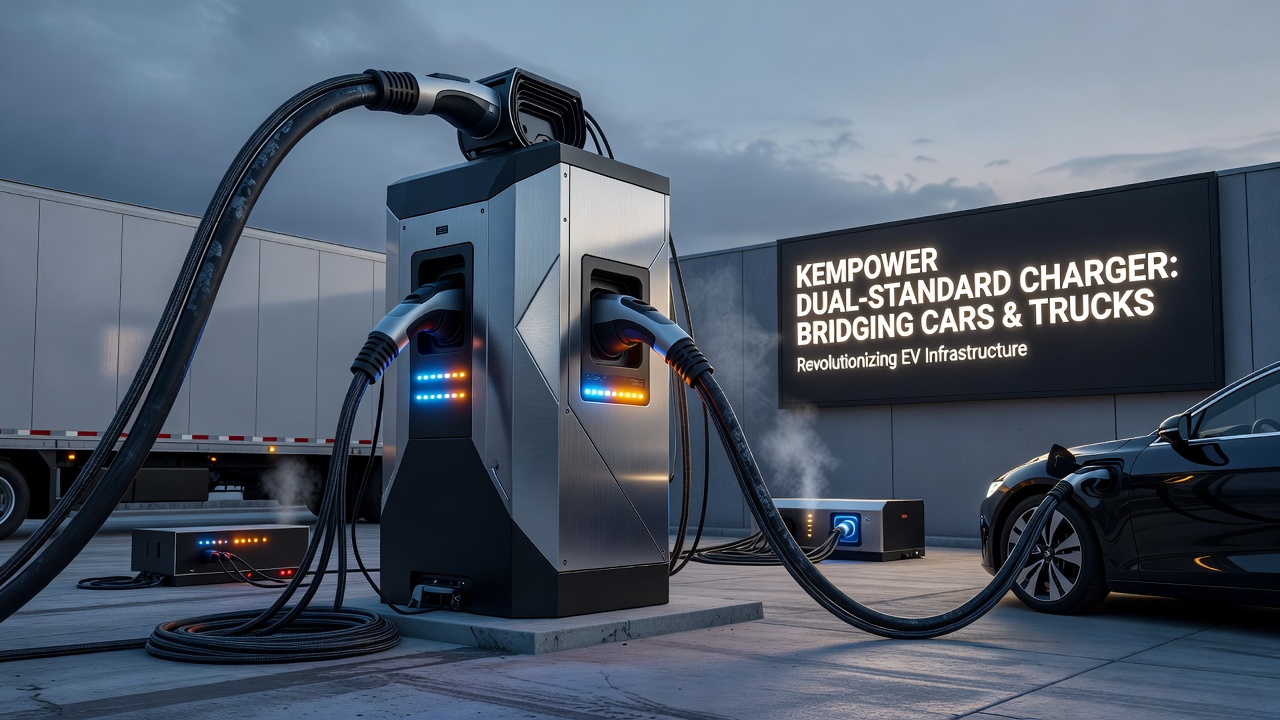
Kempower has introduced a charging dispenser that speaks two languages at once: the CCS standard that dominates today's passenger EVs, and the Megawatt Charging System designed for electric trucks that need far more power than any car battery can absorb. The new Mega Satellite Flex, unveiled this week during the company's Unplug & Recharge event at ACT Expo, delivers up to 560 kW over CCS and up to 1.2 MW under MCS from a single unit.
The timing reflects a genuine inflection point in charging infrastructure. CCS has spent years becoming the default connector for electric cars across North America and much of Europe, while MCS is only now emerging as the answer to heavy-duty freight electrification, where trucks require charging sessions measured in minutes rather than hours. Just as choosing a reliable connection matters when picking a best vpn provider for securing data on the road, fleet operators now face similarly consequential decisions about which charging hardware will still make sense five years from now. Kempower's answer is to avoid the choice altogether by building both protocols into one dispenser.
Why One Box for Two Standards Matters
Building separate charging sites for cars and trucks is expensive and often redundant, since both draw from the same grid connection and frequently occupy the same real estate along logistics corridors. By supporting CCS and MCS from a single dispenser, Kempower lets site owners serve whichever vehicle pulls in without predicting years in advance how the market will split between light-duty and heavy-duty demand. That flexibility also extends to newer 800-volt vehicle architectures, which are becoming more common among premium EVs and require higher voltage delivery to reach their fastest charging speeds.
The technical specifications underline how much headroom the unit carries. The Mega Satellite Flex supports up to 700 amps on CCS and 1,500 amps on MCS, figures that leave room for future vehicle battery packs to charge faster without forcing another hardware swap. Cable lengths of 5 meters for CCS and 2.7 meters for MCS are sized for the physical realities of trucks and cars parking at different heights and distances from the dispenser, and an optional payment terminal lets operators run the unit as a public-access point rather than a fleet-only asset.
What It Means for Operators and the Road Ahead
For charging network operators, utilization is the metric that determines whether a site turns a profit. A dispenser that can serve both a delivery van and a long-haul truck, without waiting for MCS adoption to reach critical mass, gets used more often from the day it's switched on. Kempower has also made the unit compatible with its existing distributed charging architecture, meaning operators already running Kempower systems can add the Mega Satellite Flex without redesigning their power cabinets or backend software.
The unit is expected to reach North America and Europe in July 2026, giving the industry roughly a year to prepare sites and permitting before it arrives. That window matters, because MCS infrastructure still depends on truck manufacturers finalizing compatible vehicles, and on utilities upgrading grid connections capable of delivering megawatt-level power reliably. Dual-standard hardware like this does not solve those upstream challenges, but it does remove one variable, letting site developers build now rather than waiting for the heavy-duty charging market to fully mature.