
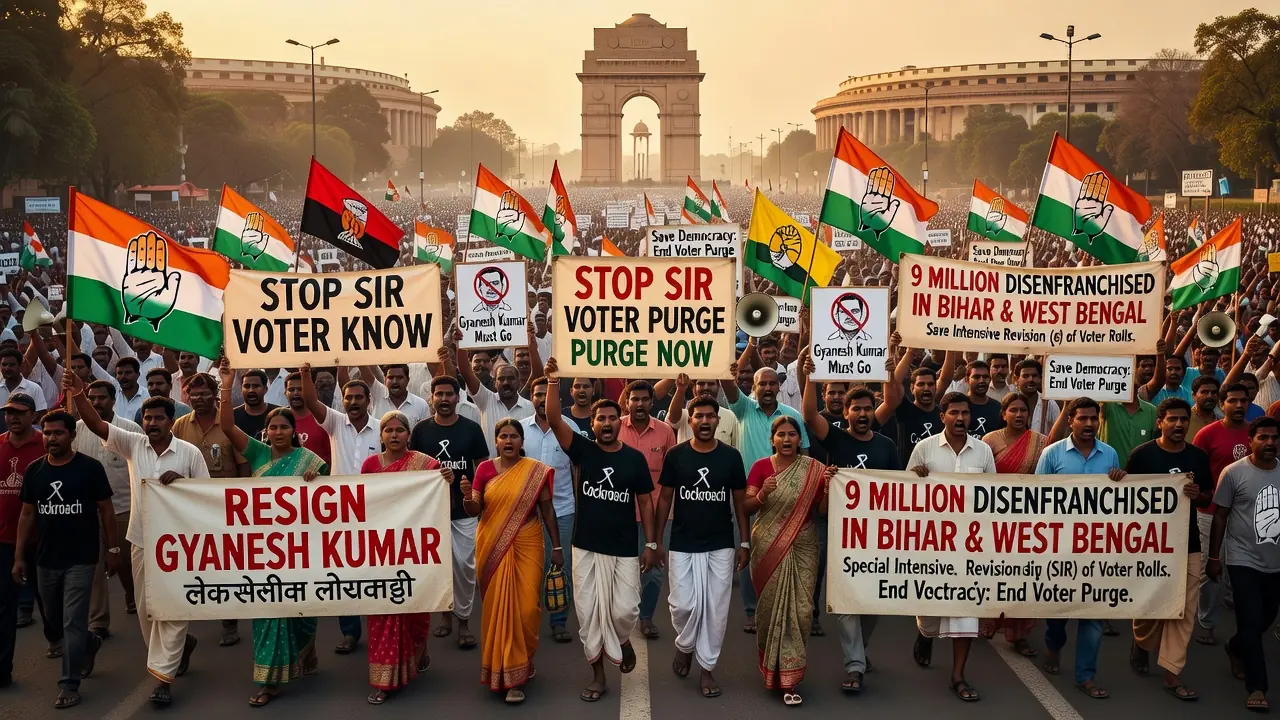
Street protests have widened across India as opposition parties, civil society groups and a youth movement known as "Cockroach" press for the resignation of Chief Election Commissioner Gyanesh Kumar. The demonstrations center on a sweeping nationwide review of voter registration rolls that critics say risks stripping millions of eligible citizens from the electoral register ahead of a crowded calendar of state elections next year.
What the voter list revision actually does
The Election Commission's Special Intensive Revision, or SIR, requires voters to resubmit documentation proving their eligibility to remain registered. The exercise began in Bihar last year before expanding across most Indian states and union territories. The commission frames it as routine cleanup work: removing duplicate entries, deceased voters and people who no longer reside at a registered address. In a country of India's scale, with the largest electorate on earth, even modest administrative error rates can translate into a very large number of affected people.
The friction lies in the paperwork burden. Many voters, particularly in poorer or rural communities, lack the older government records the revision demands. That has raised concern among opposition figures and independent observers that the process could disproportionately remove people who have every legal right to vote but simply cannot produce documents an administrative system now requires.
Why critics see a political dimension
India's Election Commission is constitutionally designed to operate independently of the government of the day. Opposition parties argue the SIR process has not lived up to that standard, alleging it could thin voter rolls in ways that disadvantage their support base while leaving BJP-leaning voters largely untouched. The BJP and the commission reject this, describing the revision as a politically neutral effort to remove what the party calls "infiltrators" from the rolls.
West Bengal's state election earlier this year sharpened these concerns. A revision there removed roughly 9 million names, about 12% of the electorate, leaving a significant number of eligible voters unable to cast ballots. The BJP won that state for the first time. Correlation is not proof of intent, but the scale of the deletions has become a reference point for critics arguing the revision process needs independent scrutiny before it expands further.
Internal dissent adds to the pressure
Reporting from the Indian Express in September disclosed that two of the commission's three members had formally objected to decisions on voter list revisions, registration procedures and the body's digital systems. Kumar reportedly rejected those objections, while the commission itself characterized the disagreements as "differing views and deliberations" rather than formal objections. That distinction matters: Indian law requires majority agreement among commissioners to enact changes, so internal splits - however they are labeled - go to the heart of how legitimately contested decisions are being made.
What comes next
Protesters are demanding more than Kumar's removal. They want the current revision halted, a return to previously certified voter lists, a formal inquiry into the commission's conduct, and a more transparent, less government-controlled process for appointing election commissioners in the future. Commission data suggesting voter rolls in some regions could shrink by as much as 30% has deepened those demands.
With several state elections approaching early next year, the dispute is unlikely to recede quickly. For a democracy of India's size, the credibility of voter rolls is not a technical footnote - it is the foundation on which electoral outcomes, and public trust in them, ultimately rest.