
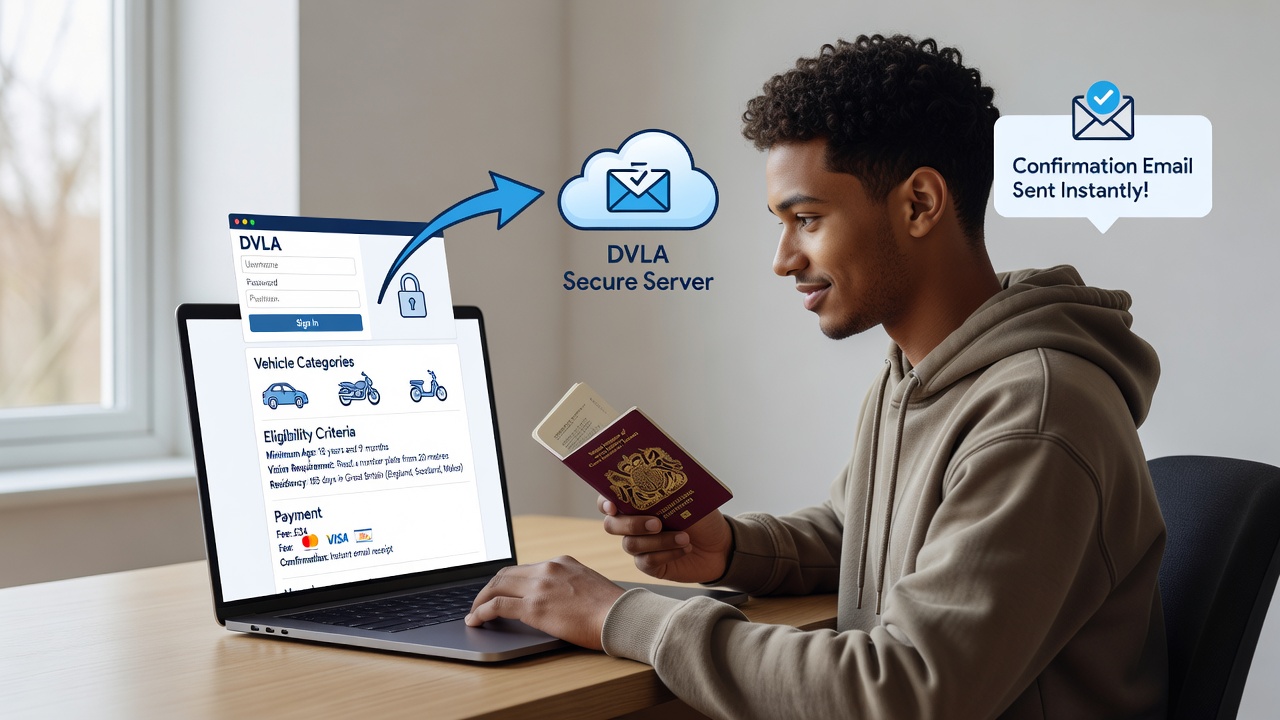
Learning to drive in Great Britain now starts with a digital application rather than a paper form. The Driver and Vehicle Licensing Agency lets first-time applicants apply for a provisional licence online, covering cars, motorbikes, mopeds and other vehicle categories. The shift reflects a broader pattern across UK public services: moving identity-linked applications away from postal processing and into verified digital channels.
Who qualifies and what it costs
Eligibility rests on three conditions. Applicants must be at least 15 years and 9 months old, able to read a number plate from 20 metres away, and have had permission to live in Great Britain - England, Scotland and Wales - for at least 185 days. The online application costs £34, payable by Mastercard, Visa, Electron or Delta debit or credit card. Anyone who first applied for a provisional licence before 1 March 1973 cannot use the standard renewal route and must apply through this service instead, since older paper-based records sit outside the current digital system.
Applying by post remains possible through form D1, available at most Post Offices, but it costs £43 - £9 more than the online route - and requires a cheque or postal order along with correct postage. The price gap is a deliberate incentive: digital applications are cheaper for DVLA to process and faster for applicants to receive, so the fee structure nudges people toward the online channel.
Identity verification and processing times
Applicants must sign in to use the service, creating credentials if they don't already have them. During sign-in, DVLA may require identity verification, typically through photo ID such as a passport. This step matters: a driving licence is a primary identity document in the UK, used well beyond the road for age verification and financial checks, so the agency has an obligation to confirm applicants are who they claim to be before issuing one.
A confirmation email follows submission. Licences typically arrive within a week for online applications, though DVLA may take longer if additional checks are needed - for example, where identity documents raise questions or where an applicant's immigration or residency status needs further confirmation.
What a provisional licence actually permits
Holding a provisional licence is not the same as being free to drive any vehicle unsupervised. Rules on what a learner can drive, and under what supervision, vary by age and vehicle type. Someone qualifying to ride a moped at 16 faces different conditions from a car learner who must be accompanied by a qualified driver. Anyone planning to start lessons should check the specific rules for their vehicle category before getting behind the wheel, since driving outside permitted conditions can amount to driving without a valid licence.
Existing licence holders have separate routes
The online service described here is specifically for first-time applicants. Drivers who already hold a provisional licence use different processes depending on their situation:
- Renewing an existing provisional licence
- Replacing one that has been lost, stolen, damaged or destroyed
- Reapplying after a disqualification
- Updating a registered address
Separating these pathways keeps the system efficient: DVLA can apply lighter checks to routine renewals while directing more scrutiny toward first applications and post-disqualification reinstatements, where identity and eligibility questions carry more weight. The service is also available in Welsh, reflecting statutory requirements for bilingual public services in Wales.