
Ninety percent of first-time B2B buyers abandon a sourcing platform within the first five minutes if they can't figure out how transactions actually work. That single statistic explains why demo environments have become standard practice across global trade platforms - and why so many prospective buyers and sellers search specifically for an alibaba demo before committing real money or real inventory to the process. A demo isn't a gimmick. It's a rehearsal space where the mechanics of quoting, messaging suppliers, comparing listings, and processing orders can be tested without financial exposure.
This matters more than most newcomers realize. Cross-border sourcing involves currency conversion, minimum order quantities, supplier verification, and shipping logistics that differ wildly from domestic retail. Getting a feel for these mechanics beforehand saves time and prevents costly missteps. For readers who want a broader sense of how demo-style trial environments function across e-commerce and trading platforms generally, the website linked here offers a useful comparative reference point. The rest of this piece walks through exactly what an alibaba demo account offers, how the alibaba website demo differs from the alibaba app demo, and what to expect from the full alibaba platform demo experience - including its limits.
What Is an Alibaba Demo and Why It Matters
An alibaba demo refers to a simulated or trial version of the platform's core functions - browsing, messaging, and transaction flow - designed to let a new user understand the mechanics before making financial commitments. It is not a separate product line; rather, it's a functional preview built into the onboarding experience or offered through guided walkthroughs that mimic real supplier interactions.
The Purpose Behind Demo Access
Global sourcing platforms serve two very different audiences at once: buyers hunting for manufacturers and suppliers trying to list products competitively. A demo bridges the knowledge gap for both. Buyers get to see how request-for-quotation forms work, how supplier ratings are displayed, and how minimum order quantities are negotiated. Suppliers, meanwhile, can preview how their storefronts will appear before publishing a live listing.
Who Benefits Most from a Demo Environment
Small business owners exploring import options for the first time gain the most from a demo. So do students and researchers studying international trade practices, and freelance consultants who advise clients on sourcing strategy without ever placing an order themselves.
- First-time importers testing supplier communication before spending money
- Dropshipping entrepreneurs evaluating catalog depth and pricing tiers
- Procurement teams comparing platform usability against competitors
- Students and analysts studying B2B marketplace design
Setting Up an Alibaba Demo Account
Creating an alibaba demo account typically starts with a standard registration process - email verification, business category selection, and a brief profile setup. The distinction from a full account lies in usage limits: demo access often restricts the number of messages sent to suppliers, caps the visibility of certain premium listings, or limits transaction simulation to a fixed number of test orders.
Registration Steps and Requirements
Most demo setups require basic identity confirmation, a working email address, and in some cases a phone number for verification. Business registration documents are rarely required at the demo stage since no real trade is happening yet - that requirement typically appears only when converting to a full seller or verified buyer account.
Verification and Account Limits
Demo accounts usually come with soft restrictions rather than hard walls. A user might be able to browse unlimited listings but only initiate contact with a handful of suppliers, or place simulated orders that never trigger actual payment processing. This design lets the platform demonstrate value while protecting both sides from fraudulent test transactions.
Switching from Demo to Full Access
Upgrading generally involves submitting business verification - a tax ID, company registration number, or equivalent documentation depending on the country of operation. Once verified, the account's messaging and transaction limits lift, and real purchase orders become possible.
Exploring the Alibaba Website Demo
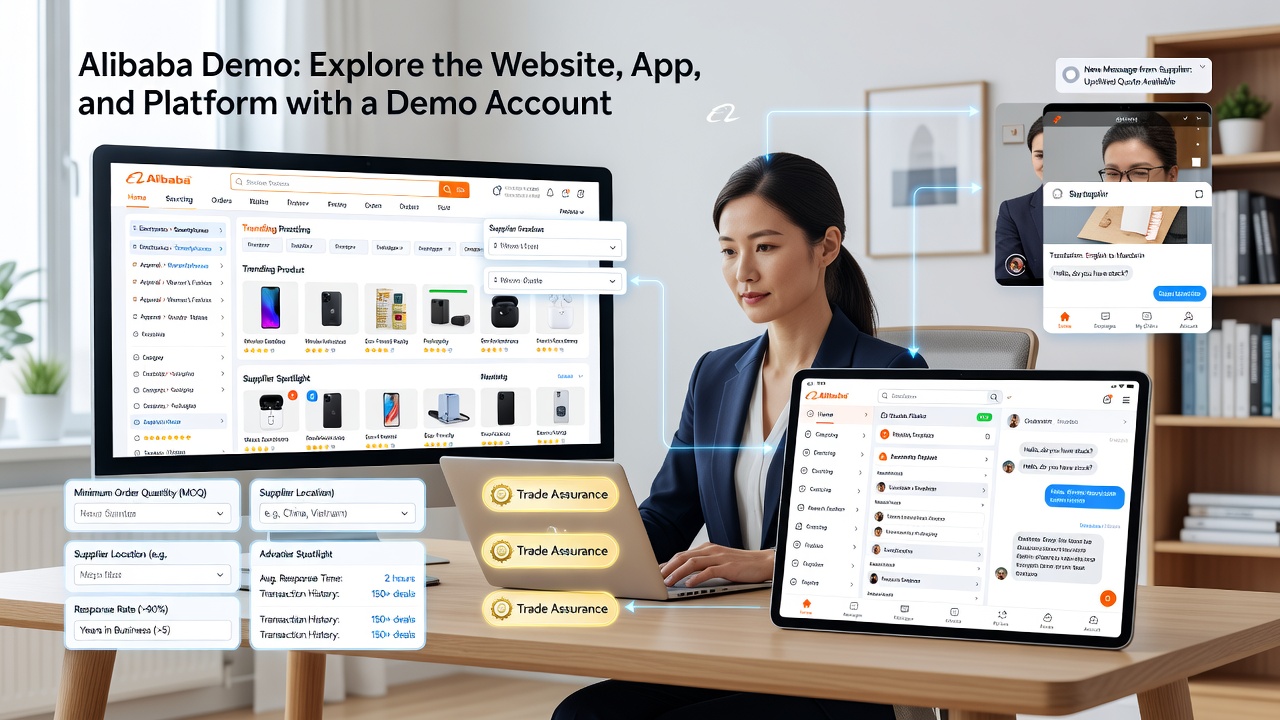
The alibaba website demo is the most detailed of the three formats because desktop browsing allows for side-by-side comparison of suppliers, bulk filtering by certification type, and detailed review of trade assurance terms - features that are harder to display clearly on a smaller screen.
Homepage Navigation and Layout
New users often underestimate how much structure exists behind the homepage. Category trees, trending product carousels, and supplier spotlight sections are all designed to shorten the path between a buyer's search intent and a relevant listing. A demo walkthrough of the homepage typically highlights these zones so users understand where to look for verified suppliers versus general listings.
Product Search and Filtering Tools
Filtering by minimum order quantity, supplier location, response rate, and years in business turns a chaotic catalog into a manageable shortlist. The website demo usually includes a guided pass through these filters, showing how narrowing criteria changes result quality - a skill that transfers directly to live sourcing later.
Supplier Profile and Rating Systems
Every supplier profile carries indicators: response time, transaction history, and sometimes third-party audit badges. Understanding how to read these signals during a demo session prevents costly misjudgments once real money is on the line.
Getting Familiar with the Alibaba App Demo
Mobile usage has overtaken desktop for a large share of B2B buyers, particularly in regions where smartphones are the primary internet access point. The alibaba app demo mirrors most website functions but compresses navigation into swipe-based menus and push notifications for supplier replies.
Mobile Interface Walkthrough
App demos usually begin with a tour of the bottom navigation bar - messages, orders, discovery, and account settings - since mobile users rely on muscle memory more than desktop users do. Icon recognition speeds up daily use once the trial period ends.
App-Exclusive Features
Certain functions exist only on mobile: real-time chat translation, camera-based product search, and instant notification of price drops on saved items. A demo session that skips these misses half the app's practical value.
Offline Access and Notifications
Some app demos also show how cached data allows limited browsing without an active connection - useful for buyers reviewing saved listings while traveling or during factory visits with unreliable signal.
The Full Alibaba Platform Demo Experience
Where the website and app demos focus on interface, the alibaba platform demo covers the entire transaction lifecycle - from initial inquiry through payment protection and dispute resolution. It's the closest simulation to an actual trade cycle without financial risk.
Order Simulation and Trade Assurance
Trade assurance mechanisms protect buyers if goods don't match agreed specifications. A platform demo typically walks through how a claim is filed, how evidence is submitted, and how refunds or replacements are processed - knowledge that reduces anxiety for first-time buyers.
Payment and Logistics Simulation
Currency conversion, freight forwarding options, and customs documentation are notoriously confusing for newcomers. A well-built demo simplifies this by simulating a purchase from quote to shipment tracking, without any actual funds changing hands.
Limitations Compared to a Live Account
Demo environments cannot fully replicate supplier negotiation dynamics, real shipping delays, or actual customs friction. Treat the demo as a map, not the territory - it teaches the interface and general flow but not every real-world variable.
Comparing Demo Access Across Devices and Platforms
Choosing between website, app, or full platform demo access depends on how a user intends to operate long-term. Desktop-heavy procurement professionals benefit more from the website demo's detailed filtering. Mobile-first entrepreneurs get more practical value from the app version.
Feature Parity and Differences
Not every feature exists identically across formats. Bulk export of supplier lists, for instance, works better on desktop, while instant photo-based search is mobile-only. Recognizing these gaps early prevents frustration later.
Performance and Usability Trade-offs
Desktop offers more screen real estate for comparison; mobile offers speed and immediacy for quick supplier replies. Neither is objectively superior - the right choice depends on daily workflow habits.
Choosing the Right Demo for Your Needs
A buyer sourcing dozens of SKUs across multiple categories should start with the website demo. A solo entrepreneur managing a handful of supplier relationships on the go will likely find the app demo sufficient on its own.
Tips for Getting the Most Out of Your Demo Session
Approaching a demo with a specific goal - rather than aimless browsing - produces far better learning outcomes.
Setting Clear Goals Before Starting
Decide in advance whether the priority is understanding supplier vetting, testing the messaging system, or learning the payment flow. A focused session teaches more in fifteen minutes than an unstructured hour of clicking around.
Common Mistakes First-Time Users Make
Skipping the trade assurance walkthrough is the most frequent error, since many new users assume payment protection works automatically. It doesn't - understanding the claims process matters as much as understanding the ordering process itself.
Transitioning from Demo to Real Transactions
Once comfortable with the interface, move to small, low-risk real orders before committing to large purchase volumes. This staged approach limits exposure while building confidence gained from the demo phase.
Question?
Is an alibaba demo account free to create?
Yes, demo access is typically free since it's designed to lower the barrier for new users to explore the platform before committing to real transactions. Some demo features may require basic email or phone verification, but no payment is required at this stage.
Question?
Can I place a real order while using a demo account?
No, demo accounts are built specifically to simulate the transaction process without processing actual payments. To place a real order, the account typically needs to be upgraded through business verification first.
Question?
Does the app demo offer the same features as the website demo?
Mostly, but not entirely. The app includes mobile-exclusive tools like camera-based product search and instant chat translation, while the website demo offers more detailed filtering and side-by-side supplier comparison better suited to larger screens.
Question?
How long does a typical demo session last before restrictions apply?
Duration varies, but most demo accounts limit usage by action count rather than time - for example, a fixed number of supplier messages or simulated orders rather than a strict time window.
Question?
Is a demo account suitable for testing supplier communication?
Yes, demo accounts generally allow limited messaging with suppliers, which is enough to evaluate response time and communication style before deciding whether to proceed with a verified account.
Question?
What happens to my demo activity after upgrading to a full account?
Demo activity, including saved listings or draft messages, is usually not carried over automatically since demo and live accounts operate on separate systems. It's best to note down useful supplier contacts or listings manually before upgrading.