
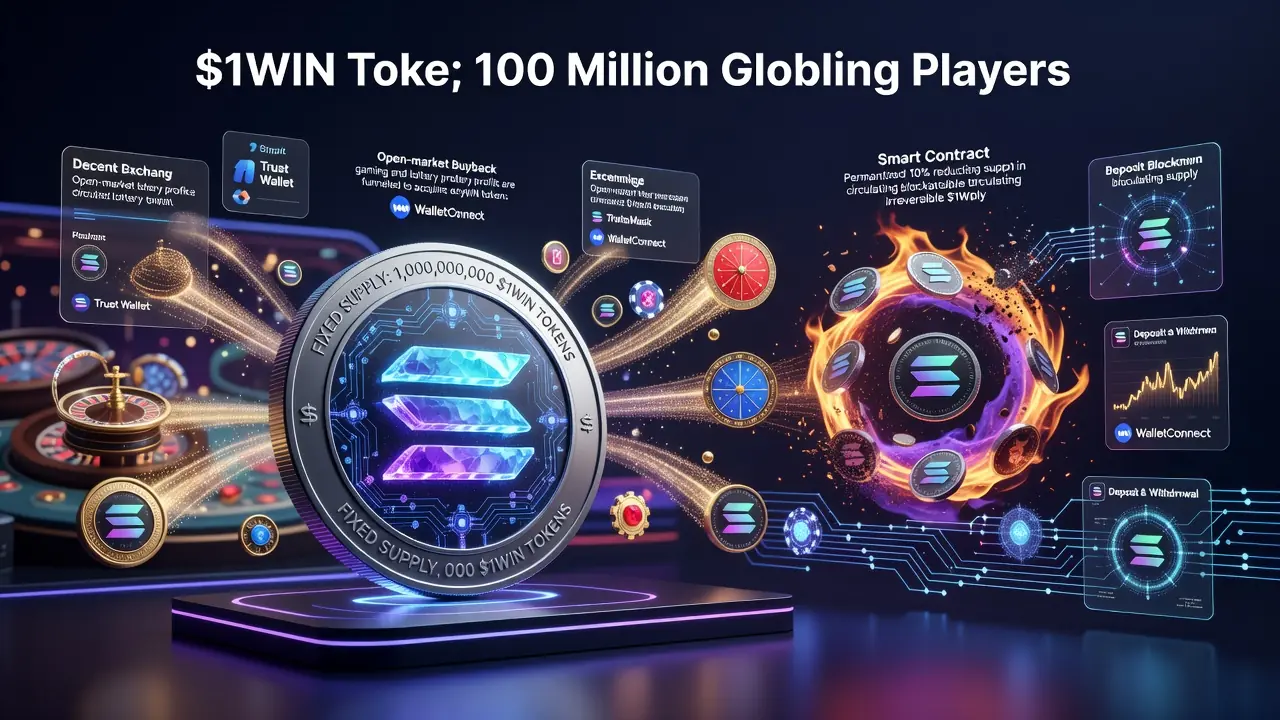
1win, a crypto-friendly gaming and entertainment platform that says it serves 100 million registered players across international markets, has announced a public sale of $1WIN, a Solana-based token built around its existing gambling and lottery products. The sale opens on October 15th at 4 pm BST and marks what the company describes as "the next stage in the rollout of $1WIN." Unlike many token launches tied to speculative future roadmaps, 1win is positioning this one as an extension of a business that already generates revenue.
What the Token Is Designed to Do
$1WIN has a fixed total supply of 1 billion tokens, with no further minting planned after the token generation event. It is intended to function across 1win's product suite, covering gaming, lottery participation, rewards, and other platform features. Because it's issued as a native Solana token, it can be held in standard Solana-compatible wallets and traded on decentralized exchanges, independent of 1win's own platform.
Two mechanisms are meant to link token value directly to platform activity. The first is an open-market buyback program funded by gaming revenue rather than a capped reserve pool - meaning purchases of $1WIN depend on ongoing business performance rather than a one-time allocation. The second is a burn mechanism: 10% of any $1WIN spent through supported platform products is permanently destroyed via smart contract, reducing circulating supply over time.
Why Operators Are Turning to Token Models
Linking a cryptocurrency token to an operating gambling business is not a new idea, but it carries distinct implications. Traditional casino loyalty points or site credits are centralized and controlled entirely by the operator. A blockchain-based token, by contrast, can be transferred, traded on external markets, and held independently of the platform that issued it. That creates liquidity and optionality for users, but it also introduces price volatility tied to open markets rather than fixed in-platform value - a meaningful distinction for anyone treating the token as more than a utility instrument within the ecosystem.
The buyback-and-burn structure mirrors mechanisms seen in other token economies, where revenue-funded purchases and supply reduction are used to support token scarcity. Whether such mechanisms translate into durable value depends on sustained business performance and actual usage, not the mechanism alone.
Wallet Integration and the Broader Web3 Push
The token launch builds on infrastructure 1win introduced earlier this year, including multi-chain crypto deposits and withdrawals and wallet-based authentication through Trust Wallet, MetaMask, and WalletConnect. That combination allows users to register, sign in, and transact using a connected crypto wallet rather than conventional account credentials - a shift that reflects a broader trend among crypto-oriented gambling platforms to merge wallet infrastructure with account access and payments.
- Fixed supply: 1 billion $1WIN tokens, no additional minting after launch
- Revenue-funded buybacks rather than reserve-funded ones
- 10% burn on token spend through supported products
- Native issuance on Solana, compatible with external wallets and exchanges
What It Means for Users
For players, a platform token adds a layer of complexity on top of standard gambling risk. Token value tied to a gaming platform can fluctuate independently of game outcomes, and cryptocurrency markets carry their own volatility separate from betting or casino odds. Consumers engaging with tokenized gambling ecosystems should treat the token itself as a financial asset with its own risk profile, distinct from - and additional to - the inherent uncertainty of gambling products. Regulatory treatment of gambling-linked crypto tokens also varies significantly by jurisdiction, and oversight in this space remains uneven compared with established gambling licensing frameworks.