
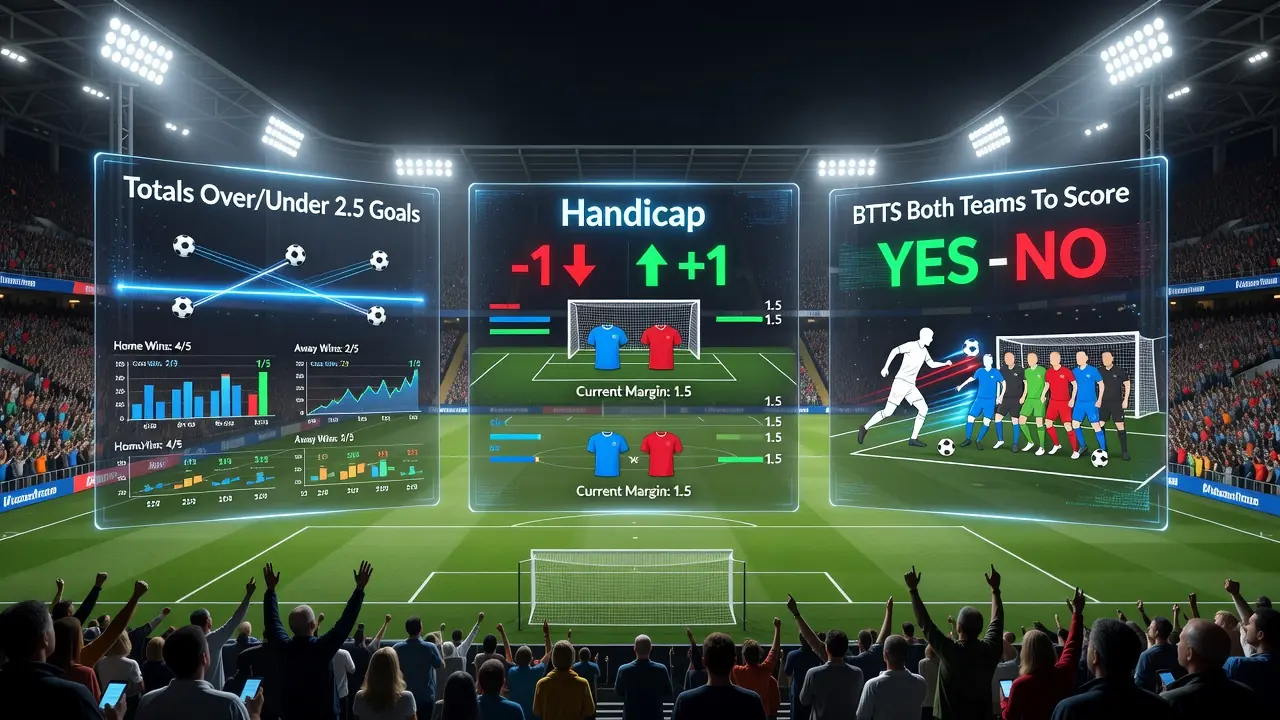
Most bettors lose money not because they pick the wrong team, but because they misunderstand the market they're betting on. Sports betting has evolved well beyond simple win/lose wagers, and the proliferation of markets like over/under, handicap, and both teams to score has changed how people engage with sport - for better and occasionally for worse. Knowing how these markets actually function is the difference between informed participation and guesswork dressed up as strategy.
Totals betting and the appeal of not picking a winner
Over/under markets, also called totals, ask a different question than traditional betting: not who wins, but how much will happen. A bookmaker sets a line - say 2.5 goals in football - and bettors decide whether the combined score will land above or below it. The appeal is structural: you're not forced to back a team, only to assess the likely rhythm of a match. That makes totals attractive in fixtures where the outcome is hard to call but the style of play is more predictable, such as a game between two attack-minded sides or two famously defensive ones. The market rewards research into team form, injuries, and tactical tendencies rather than loyalty or gut instinct, though no amount of analysis removes the underlying uncertainty of live sport.
Handicaps: compensating for mismatched teams
Handicap betting exists because lopsided fixtures make straight win/lose odds uninteresting for short-priced favorites. By applying a virtual goal advantage or deficit before kickoff, bookmakers create more balanced propositions. A team on a -1 handicap must win by two clear goals for the bet to land; the underdog on +1 can lose by a single goal and still produce a winning bet. This mechanism is a genuine innovation in how risk is priced, but it also means bettors need to think in terms of margins, not just results - a tactical shift that trips up newcomers who assume a win is always a win.
Both teams to score and the limits of attacking reputation
BTTS markets are binary and relatively easy to explain: both sides must find the net for a "yes" to pay out. The complication is that attacking reputation doesn't guarantee goals against a well-organized defense, and plenty of high-scoring teams have been shut out by disciplined opponents. Head-to-head history and defensive data matter here as much as attacking statistics, which is why BTTS is often misjudged by bettors who focus only on one side of the pitch.
Research, bankroll discipline and the reality of odds comparison
None of these markets reward impulse. Comparing odds across licensed operators, tracking bet history, and setting a fixed budget are practical habits that reduce unnecessary losses rather than guarantee returns. Live or in-play betting adds a layer of immediacy but also faster decision-making under pressure, which can erode discipline if not managed carefully.
- Totals focus on combined score, not match outcome
- Handicaps adjust for mismatches using goal margins
- BTTS depends on both attacking and defensive form
- Bankroll limits and odds comparison reduce avoidable losses
Understanding these markets improves the quality of decisions a bettor makes, but it doesn't change the fundamental nature of betting: outcomes remain uncertain, and no market structure overrides that. Treating betting as entertainment with defined limits, rather than a reliable source of income, remains the soundest approach regardless of which market a person chooses to follow.