
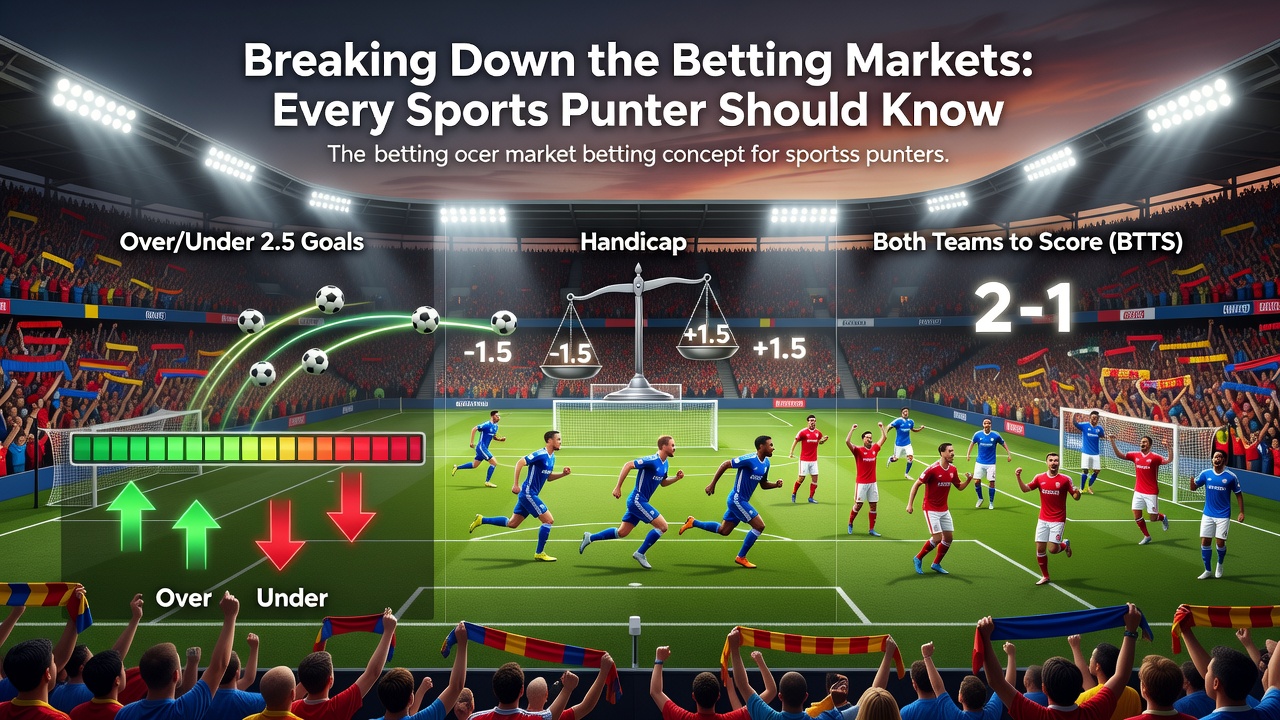
Three betting markets dominate sportsbooks worldwide: Over/Under, handicap, and both teams to score. Each offers a different lens on the same match, and understanding the mechanics behind them matters more than chasing a hunch. Bettors who grasp how these markets are priced tend to make better-informed decisions, even if no market can eliminate the underlying uncertainty of sport.
How Over/Under Works in Practice
Over/Under, also called totals betting, asks a single question: will the combined score exceed or fall short of a line set by the bookmaker. In football, a 2.5-goal line means three or more goals wins an "over" bet, while two or fewer wins "under." The half-number avoids ties, which simplifies settlement but doesn't change the fact that the line itself reflects the bookmaker's own modeling of scoring probability, adjusted to balance betting volume on both sides.
Handicap Betting and the Economics of Balance
Handicap markets exist because lopsided fixtures produce lopsided odds - and lopsided odds are hard to sell. By imposing a virtual deficit or advantage, such as -1.5 for a strong favorite, bookmakers create a more even betting proposition. This isn't a courtesy to bettors; it's a mechanism for spreading risk and keeping both sides of a market attractive. For bettors, handicaps offer better odds on favorites than a straight win bet would, but they also raise the bar for what counts as a winning outcome.
Both Teams to Score and Market Design
BTTS strips away the question of who wins and focuses purely on goal distribution. Its popularity in high-scoring leagues isn't accidental - operators promote markets that match the statistical character of a competition. A league with frequent 1-1 and 2-1 scorelines generates sustained betting interest in BTTS, which is one reason the market has become a fixture in major European football coverage.
Platforms, Payments, and What to Check
Market variety means little if the platform behind it isn't trustworthy. Before engaging with any of these markets, it's worth confirming that an operator holds a valid gambling license, displays odds transparently, and supports recognized payment methods - cards, e-wallets, or bank transfers - with clear withdrawal terms. Licensing status is the single strongest indicator of whether consumer funds and personal data are handled under enforceable rules rather than operator discretion.
- Verify licensing and jurisdiction before depositing funds
- Compare how odds are displayed across operators for the same market
- Check withdrawal processing times and fees, not just deposit convenience
- Look for visible responsible-gambling tools: deposit limits, self-exclusion, reality checks
Reading Markets Without Overreading Them
None of these markets reward guesswork over the long run, and none offer a shortcut past the house edge built into every priced line. Research into team form, injuries, and scoring trends can sharpen judgment, but it doesn't convert betting into a reliable income source. Treating these markets as entertainment with calculated risk - rather than a path to steady profit - remains the more accurate framing, and it's the one responsible operators are increasingly required to communicate clearly to their users.