
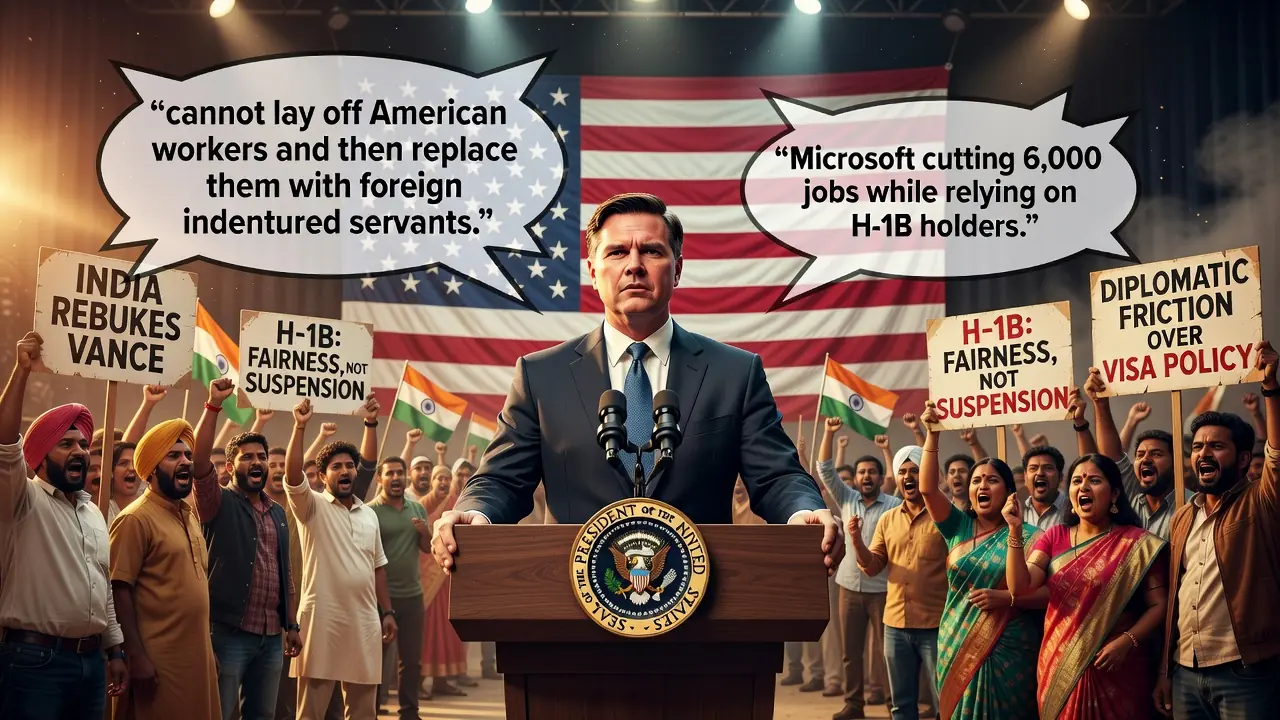
India's government has publicly condemned U.S. Vice President J.D. Vance for comments it says evoke colonial-era language about Indian workers in America. The dispute erupted after Vance defended a U.S. Department of Labor decision to suspend Microsoft, Adobe and several major Indian IT firms from the Permanent Labor Certification program, a step that blocks those companies from sponsoring green cards for employees currently on H-1B visas.
What Triggered the Diplomatic Friction
Vance argued that companies operating in the United States should prioritize American workers and said firms "cannot lay off American workers and then replace them with foreign indentured servants." He singled out Microsoft, accusing it of cutting 6,000 jobs while continuing to rely on H-1B visa holders. India's Ministry of External Affairs responded sharply, calling the phrasing "deeply offensive" and saying it carries "painful historical and colonial legacy connotations." The ministry defended Indian professionals in the U.S. as "highly educated and skilled contributors" to the American economy.
Why the H-1B Program Is Central to This Clash
The H-1B visa is the main channel through which skilled foreign workers, particularly in technology, fill roles in the U.S. labor market. According to official data cited in the dispute, roughly 70% of H-1B beneficiaries in 2025 were born in India, making any policy shift around the program disproportionately consequential for Indian nationals and the companies that employ them. The newly announced suspensions do not cancel existing visas, but they do freeze a critical pathway: permanent residency sponsorship. For workers already in the U.S. on H-1B status, India's foreign ministry was quick to clarify that current visa validity remains unaffected.
Corporate and Industry Response
NASSCOM, the Indian technology industry's trade body, pushed back on the narrative that Indian firms depend heavily on the visa category, stating that member companies have "significantly reduced their dependence on H-1B visas" and are increasingly hiring domestically within the U.S. Tata Consultancy Services, the largest Indian IT company by size, said its H-1B applications have fallen to "single digits" over the past two years and committed to hiring 15,000 people in the U.S. over the next five years. The companies named in the suspension, including Cognizant, Infosys, Capgemini, Wipro and HCL, represent a significant share of the outsourcing and IT services sector that has historically used H-1B sponsorship as a bridge to long-term U.S. operations.
The Broader Policy Context
This is not the first friction point around H-1B policy under the current U.S. administration. In June, a federal judge blocked a proposed $100,000 fee on H-1B applications that President Trump had sought to impose, signaling that immigration-linked labor policy remains legally contested and politically volatile. The latest suspension adds another layer of uncertainty for multinational employers who must now weigh workforce planning, compliance costs and diplomatic optics simultaneously. For India, the episode underscores a dependency it has sought to narrate differently: not as reliance on foreign labor markets, but as a bilateral exchange of skilled talent that benefits both economies. The ministry's statement framed the suspensions as counterproductive, stating plainly that they "do not advance the shared ambitions of both countries."