
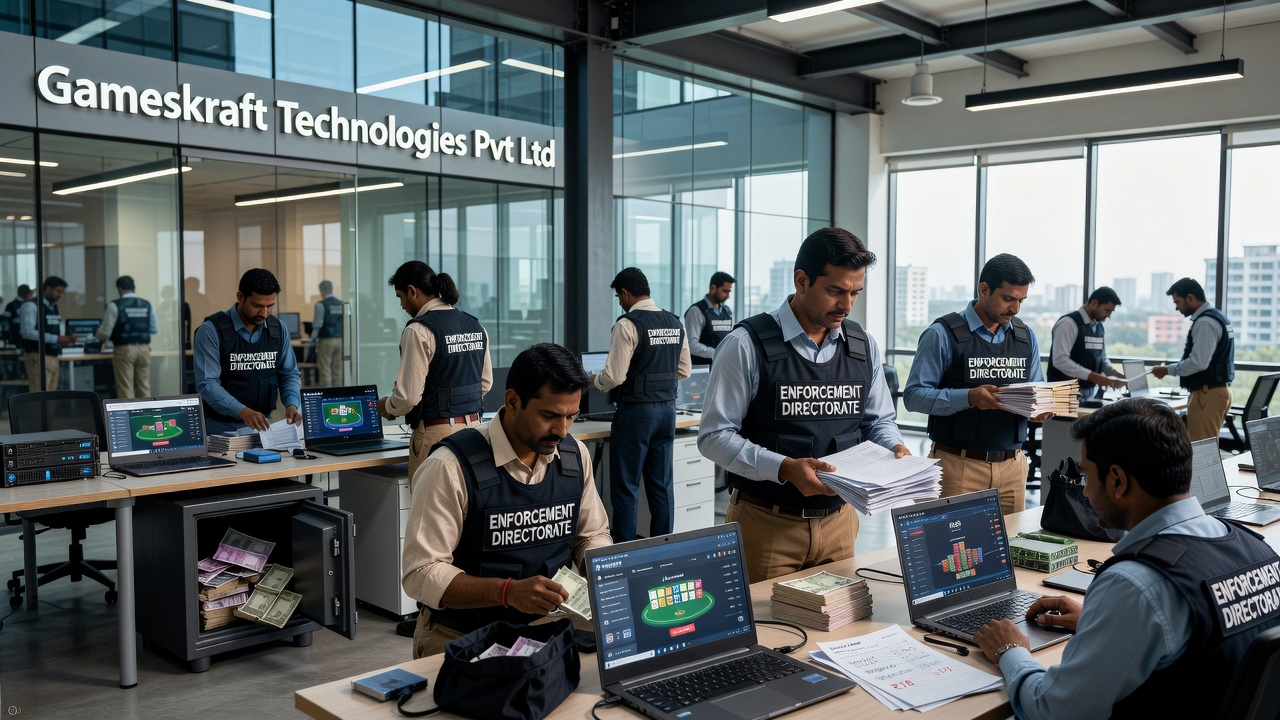
Federal investigators expanded a sprawling money laundering probe into India's online gaming sector on Thursday, May 7, when the Enforcement Directorate's Bengaluru Zonal Office conducted coordinated searches across Delhi-NCR, Bengaluru and other cities. The operation targeted Gameskraft Technologies Pvt Ltd, its directors, and several individuals linked to online betting activities allegedly connected to proceeds worth roughly ₹1,000 crore.
The raids form part of a case distinct from an earlier round of searches the agency conducted against Gameskraft last year, underscoring how the company has now become the subject of multiple, overlapping investigations. What makes this particular case notable is the mechanism through which it reached the ED: several FIRs were first filed with local Bengaluru police, then absorbed into the federal probe under the Prevention of Money Laundering Act, a common escalation path when local complaints point to organised financial crime. For ordinary users navigating the crowded gaming app market, episodes like this are a reminder to scrutinise how platforms handle withdrawals and fund segregation - features that legitimate operators, including those offering a no wagering casino experience, are increasingly expected to disclose transparently rather than bury in fine print. no wagering casino
Officials reportedly seized documents, digital records and electronic devices during the searches, standard procedure in financial crime investigations where evidence of fund flows and platform operations often resides in servers, backup drives and internal communications rather than paper trails.
The Pocket52 Connection and Escrow Concerns
The current searches follow an earlier phase of action, between November 18 and 22, 2025, when the ED raided premises linked to Nirdesa Networks Pvt Ltd and Gameskraft in Bengaluru and Gurugram. That investigation stemmed from Karnataka Police FIRs alleging fraud on Pocket52, a gaming platform operated by Nirdesa Networks. Complainants alleged manipulated game outcomes, player collusion, and restricted withdrawals - allegations that, if substantiated, would strike at the core trust mechanisms any real-money gaming platform depends on. One complainant alone reportedly claimed losses exceeding ₹3 crore.
Central to the case is the question of escrow accounts - the ring-fenced accounts platforms are meant to use to hold player funds separately from operational revenue. According to the ED, more than ₹30 crore remained undistributed in escrow accounts despite restrictions under the Online Gaming Promotion and Regulation Act, 2025. The agency has since frozen eight escrow accounts holding an estimated ₹18.57 crore, treating the funds as suspected proceeds of crime.
Why Escrow and Withdrawal Practices Matter
Escrow arrangements exist precisely to protect users from platforms that might otherwise treat customer deposits as working capital. When funds are not returned promptly, or when withdrawal mechanisms are opaque, it raises structural questions about how a platform is managing liquidity and whether player money is being commingled with company finances. This is a recurring pressure point in the real-money gaming industry globally, not unique to India, and it is one reason regulators everywhere have moved toward mandating segregated accounts and independent audits.
Allegations of algorithmic manipulation add another layer of concern. Games advertised as skill-based or governed by fair random-number generation depend entirely on user trust in systems they cannot personally verify. Any credible allegation of rigged outcomes threatens that trust model directly, which is why regulatory scrutiny in this sector increasingly focuses on platform auditability rather than just financial reporting.
Implications for the Wider Gaming Industry
The case illustrates how India's regulatory architecture around online gaming is tightening in real time, with the PROG Act's escrow requirements now serving as an active enforcement lever rather than a dormant compliance clause. For operators, it signals that fund-handling practices are under direct examination, not just tax or licensing compliance. For users, it is a reminder that real-money gaming platforms, regardless of how polished their interfaces appear, carry financial and operational risks that go beyond the odds of any individual game.
- Multiple FIRs escalated from state police to a federal money laundering probe
- Allegations include manipulated outcomes, collusion, and withheld withdrawals
- Escrow accounts holding player funds are now central to the investigation
- Roughly ₹18.57 crore across eight accounts has been frozen pending probe
As the investigation continues, the case is likely to influence how regulators approach compliance verification across India's broader online gaming and betting industry, particularly around fund segregation, algorithmic transparency, and timely payouts to users.